How to Choose the Right Polishing Compound for Your Paint
Selecting the appropriate polishing compound is a fundamental step in any paint correction process. The decision influences how effectively surface imperfections such as swirl marks, light scratches, and oxidation are addressed, while also determining the final clarity and gloss of the finish. Two primary variables define a compound’s behavior: the size of the abrasive particles (grit) and the chemical formulation that carries them. Understanding these elements helps practitioners make informed choices based on the condition of the paint and the desired outcome.
Polishing compounds are not one-size-fits-all products. They range from aggressive heavy-cut blends designed to remove deeper defects to ultra-fine finishing polishes that refine the surface to a mirror-like gloss. The interaction between grit size, lubricity, and chemical activity determines how much material is removed and how finely the surface is leveled. This article breaks down the key factors involved in selecting a compound, focusing on grit characteristics, chemical composition, and the practical contexts in which different levels of cut are appropriate.
It is important to note that no single compound guarantees a perfect result. The effectiveness of any polish depends on multiple variables, including the condition of the paint, the type of applicator pad, machine speed and pressure, and the ambient environment. The following sections provide a conceptual framework to guide the selection process rather than prescribe fixed solutions.
Understanding Grit Size and Cutting Power
The abrasive particles within a polishing compound are graded by size, often measured in microns or referenced by traditional grit numbers. Larger particles (coarser grit) create deeper scratches that remove a greater amount of clear coat or paint per pass. This aggressive cutting action is useful for eliminating moderate to heavy defects such as sanding marks, deep swirls, or etched contaminants. Conversely, smaller particles (finer grit) produce shallower scratches that level the surface with minimal material removal, resulting in a smoother, more reflective finish.
Cutting power is not solely a function of particle size; it also depends on the shape of the abrasive crystals and how they fracture under pressure. Some compounds use engineered abrasives that break down during use, starting with a coarser cut and gradually becoming finer. This allows for a one-step process that can combine cutting and polishing. However, the initial particle size still determines the maximum depth of cut achievable. Practitioners should consider the severity of the paint defects: heavy oxidation or clear coat scratches often require a compound with larger grit, while minor hazing or holograms respond better to finer abrasives.
It is also worth noting that the carrier medium—the liquid or paste that suspends the abrasives—affects how the particles behave. A thin, fast-evaporating carrier may lead to a more aggressive cut because the abrasive stays in contact with the surface longer. A thicker, more lubricating medium can cushion the particles, reducing cut and increasing finish quality. Therefore, grit size must always be evaluated in conjunction with the overall formulation.
Chemical Composition and Its Role
Beyond the physical abrasive, the chemical components of a polishing compound play a significant role in cutting performance and final appearance. Many compounds contain lubricants to reduce heat and friction, which helps prevent the paint from becoming too hot and potentially damaging the clear coat. Lubricants also allow the abrasive particles to glide across the surface, minimizing micro-marring and promoting a more even cut.
Some formulations incorporate chemical agents that soften or swell the clear coat temporarily. This can enhance the cutting effectiveness of the abrasive, as the softened paint is easier to remove. However, such compounds require careful monitoring because they can alter the working time and may leave residues that need to be fully removed before final inspection. Solvent activity varies between products; water-based compounds tend to have less chemical action compared to solvent-based alternatives, which can affect both cut and dusting behavior.
Another aspect of chemical composition is the presence of fillers or glazing agents. These materials are designed to temporarily hide minor defects by filling them, rather than removing the surrounding clear coat. While fillers can improve the immediate appearance, they may wash away after the first few washes, revealing the underlying imperfections. For long-lasting correction, compounds that rely primarily on abrasive action rather than fillers are generally preferred. Elite Car Care, for example, offers compounds that balance chemical lubrication with mechanical abrasion, allowing for consistent results across different paint types.
Practitioners should test a small area to understand how a compound interacts with the specific paint system. Environmental factors like temperature and humidity can affect the evaporation rate of the carrier and the behavior of chemical activators. A compound that works well in a cool, dry environment may behave differently in humid or hot conditions.
Heavy Cut Compounds: When and How to Use
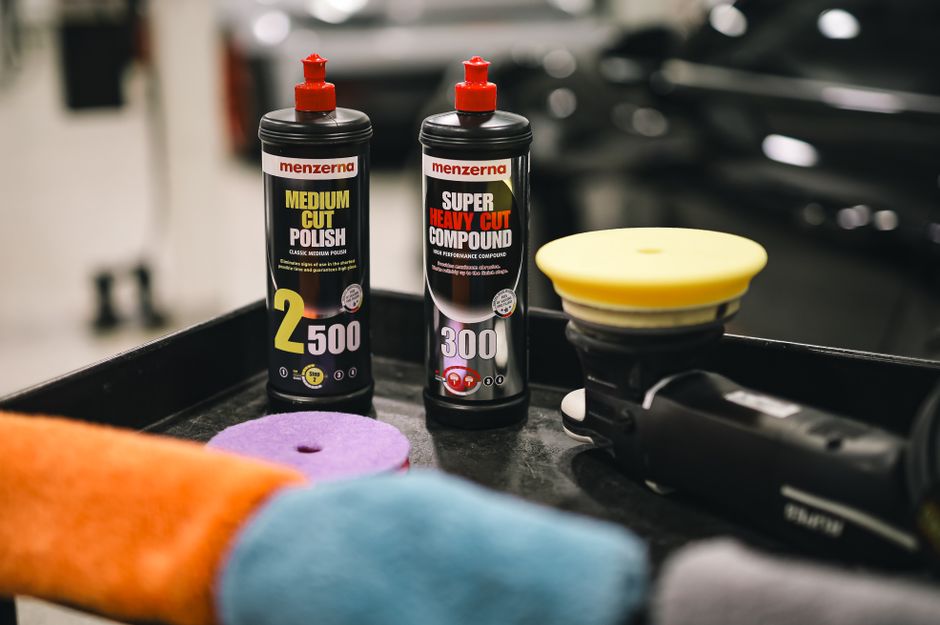
Heavy cut compounds, often labeled as “cutting” or “heavy duty,” are formulated with relatively large abrasive particles and a strong carrier medium. They are intended for situations where a significant amount of clear coat needs to be removed to level deep scratches, remove overspray, or correct heavy oxidation. Using a heavy cut compound typically requires a dense, non-foam cutting pad and a machine with sufficient power, such as a rotary or a high-torque dual-action polisher.
The application process for a heavy cut compound differs from finer polishes. The compound should be worked in a small area at moderate speed and pressure, allowing the abrasives to break down and cut effectively. It is common to use multiple passes, checking the progress after each section. Heavy cut compounds often leave a dull, hazy finish due to the deep scratches they generate. This is expected and is usually followed by one or more finishing steps with progressively finer polishes.
It is essential to recognize that clear coat only has a limited thickness—typically between 1.5 and 2.5 mils (about 38 to 64 microns). Aggressive cutting removes material permanently. Therefore, heavy cut compounds should be applied only when necessary and with care, especially on thin or previously corrected paint. Measuring paint thickness with a gauge before proceeding is a recommended practice. The goal is to remove only enough material to eliminate defects, not to strip the coating unnecessarily.
Finishing Polishes: Purpose and Application
Finishing polishes, also referred to as “fine” or “final” polishes, contain very small abrasive particles designed to refine the surface after a heavy cut or to address light defects such as water spots, light swirls, or haze. Their primary purpose is to create a high-gloss, defect-free finish with minimal material removal. Finishing polishes rely on a combination of fine abrasives and high lubricity to burnish the surface rather than cut it.
These products are typically used with soft foam finishing pads and lower speeds on the polisher. The technique involves applying the polish to the pad, spreading it over a moderately sized section, and then working it until the abrasives diminish. The residue should wipe cleanly away, leaving a smooth, reflective surface. Because finishing polishes remove very little clear coat, they are safer for use on delicate paints or for everyday maintenance detailing.
An important distinction between finishing polishes and all-in-one compounds is the level of defect correction possible. A finishing polish will not remove deep scratches or heavy oxidation; attempting to do so would require excessive passes and pressure, potentially generating heat and holograms. Instead, it is best suited for final refinement after a more aggressive step, or for lightly marred paint that only needs a gentle polish. When used correctly, a finishing polish can enhance the depth and clarity of the paint without compromising the integrity of the clear coat.
Matching Compound to Paint Condition
The practical decision between a heavy cut compound and a finishing polish depends on a careful assessment of the paint’s condition. Visual inspection under direct lighting reveals the density and depth of defects. Running a clean fingernail or a plastic trim tool over a scratch can give a rough idea of how deep it is—if the fingernail catches, the defect likely requires a heavy cut. If the scratch is only visually noticeable in bright light, a medium or fine polish may suffice.
Panel-by-panel evaluation is recommended because paint thickness and hardness can vary across a vehicle. For example, horizontal surfaces like the hood and roof often receive more UV exposure and may be more brittle, while vertical panels might be softer. A compound that works well on the door may behave differently on the roof. Additionally, factory paints and resprays have different hardness levels; aftermarket paint is often softer and requires gentler compounds to avoid burn-through.
Testing a small inconspicuous area with the selected compound before proceeding to the entire vehicle allows the practitioner to observe the cut rate, the amount of residue, and the resulting gloss. This test also reveals how the compound interacts with the specific paint and pad combination. Based on the results, the compound choice can be adjusted—either moving to a more aggressive product if the defect remains, or stepping down to a finer polish if the surface is already smooth. This iterative approach reduces risk and improves the likelihood of a satisfactory outcome.
Factors to Consider Beyond the Compound
While the compound is central to the polishing process, several other factors influence the final result. The choice of applicator pad is critical: cutting pads with an open-cell structure or woven fibers work with aggressive compounds, while finishing pads with closed-cell foam or microfiber surfaces enhance the gloss. Pad firmness and diameter affect both cut and finish, and using the wrong pad can compromise the compound’s intended performance.
Machine operation parameters—such as rotation speed, orbit size, and downward pressure—also modify the effective cutting power. Higher speeds and greater pressure increase cut, but also generate more heat, which can dry out the compound and reduce lubricity. Finding a balance that maintains a consistent slurry is part of the learning process. For dual-action polishers, the orbit size (distance the pad moves) influences how much cut occurs; larger orbits create more aggressive action.
Environmental conditions like ambient temperature, humidity, and cleanliness of the workspace affect the compound’s working time. Dust from previous sanding or polishing steps can contaminate the surface and introduce new scratches. Proper preparation, including washing, decontaminating, and claying the paint before any abrasive step, lays the foundation for effective polishing. Ultimately, selecting a compound is one part of a broader system that includes technique, equipment, and careful inspection. By understanding the properties of grit and chemistry, and by respecting the limitations of each product, practitioners can make informed choices that align with their specific goals.